Philips Healthcare has recently announced that all Philips Heartstart Onsite and FRx AED's sold after 12-1-2012 will now come with an 8 year manufactures warranty.Shop for Philips AED's today!
Philips FR3 Defibrillator Now Available
Philips has announced release and FDA clearance of the new Philips FR3 Defibrillator. The new Philips FR3 AED is feature packed with goodies for EMS and professional providers, making the Philips FR3 an easy choice for fire departments, medical clinics, dental offices and more. With ECG options, pediatric capability and data management options, the Philips FR3 is in a class all its own. Find out more about the new Philips FR3 AED. NEW INFORMATION REGARDING ZOLL AED PLUS 2010 UPGRADES- UPDATED 12-23-2011 ZOLL will offer the ZOLL AED PLUS 2010 upgrade software for free via download from their site.
The interface stickers are also now available. To perform
the ZOLL AED Plus upgrade, you will need an USB IRDA Adapter to transfer the new software to the AED. Once the upgrade has been completed, you must register the upgrade with ZOLL. Questions about the ZOLL AED Plus 2010 upgrade? Just call us at 866-517-8243.
Defibtech Announces a Corrective Action on Certain Defibtech Lifeline AED's
Over the next few weeks Defibtech and their distributors will be notifying customers regarding a corrective action that will be required on certain Defibtech Lifeline AED's manufactured prior to 2009. You can review the customer letter or check and see if your AED is affected by the corrective action.
During the 2010 Special Session, the Legislature passed Senate Bill 1033. This
bill requires each school campus to have at least one automated
external defibrillator (AED) on premises. Compliance is required on or
before January 1, 2015. The new Oregon AED law applies to all public schools, private and charter schools in the state of Oregon.
Northwest
Health and Safety Inc is a leading provider of AED's and AED programs
to schools and businesses. We have established hundreds of school based
AED programs from AED planning, AED Selection, Placement, Policies and Procedures, EMS integration, Training,
Medical Direction and Oversight. Northwest Health and Safety Inc. has
the resources and understanding of AED programs to make sure your school
has all the information to put together a successful and affordable AED
program. We work with all the leading AED manufactures from Cardiac Science, ZOLL, Defibtech, Physio-Control, Philips and Heartsine.
We have special discount pricing and programs for Oregon schools
affected by the new AED requirement. Have questions about AED's? Just
call and we'll be happy to assist you. 1-866-517-8243 or visit us online
at AEDUniverse.com or AED4U.com
American Heart Association releases 2010 CPR/AED and First Aid Guidelines On October 18, 2010 the American Heart Association released the new CPR and First Aid guidelines. The ABC's are now CAB's. The new guidelines now call for doing compressions FIRST once unresponsiveness has been determined. What does this mean for AED's? It is yet to be seen how the AED manufactures will respond with software updates to match the 2010 guidelines. We don't really expect software changes on most AED units, other than the ZOLL AED Plus. ZOLL is expected to release software updates about the end of the first quarter 2011. We will post upgrade information for all AED's when they become available. You can view all of the new CPR and First Aid changes for 2010. - AHA Website.
To get trained in the new 2010 CPR and First Aid guidelines visit us at nwcprtraining.com
Philips AED Promotion on now thru September 24, 2010 Philips Healthcare is now offering a trade in credit when you trade in your existing (Non-Philips) AED and receive $100 credit towards the purchase of a Philips Heartstart Onsite AED or a $200 credit towards the purchase of a Philips Heartstart FRX AED.
Contact
Northwest Health and Safety Inc for more details on this great promotion at (866) 517-8243
Medtronic Physio-Control is back and better than ever On February 19, 2010 Medtronic Physio-Control announced that the FDA has given a green light to resume shipping their entire product line world wide without restrictions. The announcement comes after Physio-Control voluntary suspended shipping of it's AED line while they worked with the FDA to restructure it's quality processes and systems. We are proud to announce that the LIFEPAK CR Plus and LIFEPAK 1000 AED's will resume full shipments. Physio-Control also announced that the LIFEPAK CRPlus will now come standard with an 8 year worry free warranty (the longest warranty in the industry). You can shop online for Medtronic Physio-Control LIFEPAK products at AEDUniverse.com Cardiac Science Notifies AED Customers of Nationwide Voluntary Medical
Device Correction
BOTHELL, Wash., Nov 13, 2009 /PRNewswire-FirstCall via COMTEX News Network/
-- Cardiac
Science Corporation (Nasdaq: CSCX) is initiating a voluntary field
correction after it was determined certain automated external defibrillators
(AEDs) may experience a rare product issue in which the AED may not be able to
deliver therapy during a resuscitation attempt. Device failure may affect
resuscitation of the patient, which could lead to serious adverse events or
death. These AEDs have electronic components which may fail and the failure may
not be detected by the device's periodic self-tests. The affected models include
the Powerheart 9300A, 9300C, 9300D, 9300E, 9300P, 9390A, 9390E, and CardioVive
92531, 92532, and 92533 devices. Read more about the Cardiac Science Medical Device Correction
New Oregon Law To Take Effect January 2010Oregon SB 556 which requires owners of buildings greater than 50,000 square feet and 25 or more visitors a day to have a defibrillator and someone trained to use it on site. Schools and churches will be exempt from the requirement. See the full statute UPDATE: This law has been amended to 50 visitors or where 50 people congregate. There is no changes to the 50,000 square foot requirement.
The New Jersey bill, S2146 passed both the state Senate and Assembly and was signed into law April 23.
It extends to assisted living facilities the same requirements for AED
placement and staff training that currently apply to nursing homes and
other health-related institutions in the state. Assisted living
facilities must meet the requirements of the new law within one year. New Jersey law will require assisted living facilities to have both an automated external defibrillator (AED) and someone trained in its use on site. See the full statute
Philips Healthcare Discontinues the Philips Heartstart FR2 Plus AED. After 9 years on the market Philips will discontinue the Heartstart FR2 Plus AED. Philips will still honor all warranties presently in place. AED Accessories will also remain available for the foreseeable future. Philips is offering trade in credit for customers wishing to move to the Philips Heartstart FRX AED. Some FR2's may be available refurbished on a limited basis. Call us for all the details. Read the End of Life Bulletin from Philips Texas Implements AED LegislationSeptember, 2009 - Texas House Bill 392, which requires the placement of an Automated External Defibrillation (AED) in all nursing homes and related institutions, goes into effect on September 1, 2009.In 2008, Texas nursing homes served more than 56,000 Texans, some of
whom are among the most vulnerable and medically fragile citizens of
the state. However, as of 2002, only 4 percent of nursing homes had an
AED in their facility. On average among this population, the survival
rate of cardiac arrest outside of a hospital without the use of an AED
or CPR is about 6 percent.Read Texas HB 392 Illinois passes AED Legislation for Dental Offices Illinois has passed HB921 which will require dental offices that administer anesthesia or sedation to have an Automated External Defibrillator on premise. Illinois HB 921 is now part of the Illinois Public Act 096-0748. The new requirement will take effect on January 1, 2010. Read full statute
Washington Rule Requiring Dentist to have an AED on premise? Is it still a rule or not? Short answer is Yes WAC-246-817-722 stands as written. While the Dental Quality Assurance Commission (DQAC) originally repealed the requirement to its rule requiring automated external defibrillators in certain dental offices that administered anesthetic. On May 1, 2009 the DQAC upheld the requirement that requires AED's in Washington state dental offices that administer anesthetic.
While this leaves the original rule (WAC 246-817-722) in effect,
DQAC has also begun the administrative process to amend the rule with
attention to two issues: exempting offices which administer only
topical anesthetics and allowing adjoining offices to jointly comply
with the rule using a single AED.
Because opposition to repealing the rule was expressed, DQAC was
unable to use the states expedited repeal process. If approved, the
revised rule would likely not be effective until March 2010. DQAC
members clarified that the commission does have discretion in not
pursuing complaints regarding AEDs in the interim.
AEDUniverse.com will be providing Washington Dentists with discounted AED pricing to help meet this requirement.
WAC 246-817-722 Every dental office in the state of Washington that administers
anesthetic must have an automatic external defibrillator (AED) or
defibrillator. The dentist and staff must be prepared to use this
equipment in an emergency.






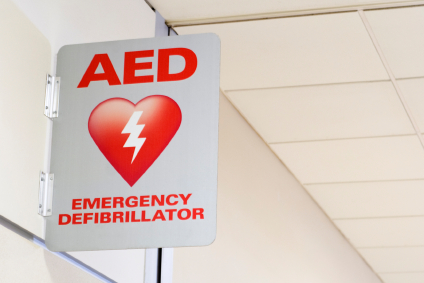
 This
bill requires each school campus to have at least one automated
external defibrillator (AED) on premises. Compliance is required on or
before January 1, 2015. The new Oregon
This
bill requires each school campus to have at least one automated
external defibrillator (AED) on premises. Compliance is required on or
before January 1, 2015. The new Oregon